EU Waste Rules Leave Cartridge Questions
November 23, 2026
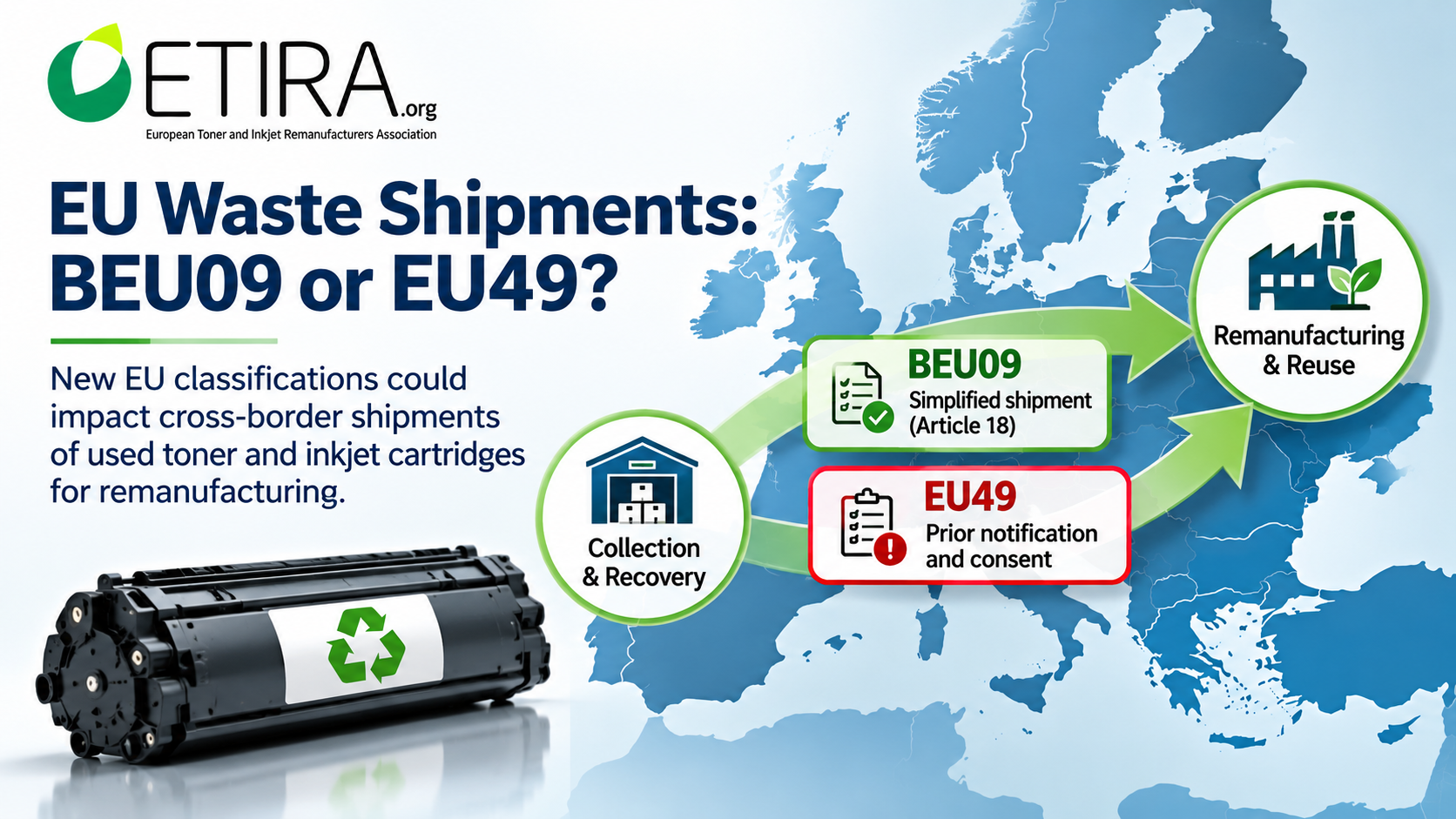
The European Commission has adopted new waste shipment classifications, but ETIRA warns that uncertainty remains over cross-border movements of used toner and inkjet cartridges destined for remanufacturing.
The European Commission adopted a Delegated Regulation on 26 October 2026 introducing new classifications for shipments of electrical and electronic waste between EU Member States. Intended to simplify the movement of certain non-hazardous waste streams while maintaining environmental controls, the changes nevertheless leave an important question for Europe’s toner and inkjet cartridge remanufacturers: will collected empty cartridges qualify for simplified cross-border shipment procedures, or face more demanding requirements for prior notification and consent?
The new rules amend Regulation (EU) 2024/1157 and replace the existing GC010 and GC020 classifications, which cease to apply from 1 January 2027. Two new entries are particularly relevant: BEU09, covering specified non-hazardous electrical and electronic waste, and EU49, covering waste electrical and electronic equipment and components not classified under A1181 or BEU09.
What Changes Under BEU09?
BEU09 allows qualifying non-hazardous electrical and electronic waste to move between Member States under the general information requirements of Article 18, rather than the more demanding prior written notification and consent procedure. The adopted wording covers equipment that has undergone proper treatment under the WEEE Directive, components derived from such treatment, and specified sorted waste fractions. The materials must also satisfy the applicable requirements concerning hazardous properties.
ETIRA considers that used toner and inkjet cartridges may qualify as waste components of electrical and electronic equipment, provided the relevant conditions are met. However, cartridges are not explicitly named, and the requirement for prior treatment of the equipment raises questions about collected empties that have not yet been sorted or processed. Where waste electrical and electronic equipment or its components fall outside BEU09 and are not covered by A1181, the EU49 classification would require prior notification and consent, potentially adding significant costs, delays and administrative burdens.
European cartridge remanufacturers rely on established collection networks recovering used cartridges from businesses, institutions and consumers across several Member States. These are transported to specialist facilities for inspection, sorting and assessment for remanufacturing or material recycling. Efficient cross-border movement is essential to the economic viability of these operations, particularly where collected cartridges must be consolidated before suitable products can be selected for another useful life.
In its September consultation response, ETIRA argued that controlled, traceable shipments between authorised professional operators should benefit from proportionate procedures supporting preparation for reuse. It also called for consistent classification across Member States, where differing national and regional interpretations already create uncertainty and expense. The concern is that the new rules may not resolve these difficulties, potentially subjecting non-hazardous collected cartridges intended for legitimate remanufacturing to more demanding shipment procedures.
Other European organisations raised similar concerns during the consultation. Like ETIRA, the European Remanufacturing Council requested that printer cartridges be explicitly included under BEU09 to avoid differing interpretations and sought clarification of the evidence required to demonstrate their non-hazardous status. Spain’s recycling association FER argued that non-hazardous electrical and electronic waste should not face more burdensome procedures simply because it has not yet undergone treatment. Both contributions underline the importance of classifications that can be applied consistently without obstructing legitimate recovery and reuse activities.
ETIRA Calls for Harmonised Interpretation
ETIRA supports the Commission’s objective of facilitating environmentally sound waste shipments within the European single market, but believes the framework must recognise the practical requirements of cartridge collection and remanufacturing. Even shipments qualifying under Article 18 remain subject to documentation requirements, including advance submission of shipment information. ETIRA has previously questioned the proportionality of the two-working-day advance submission requirement for routine commercial movements.
The association will now seek clarification from the Commission and national authorities. Its priorities include establishing how collected empty cartridges should be classified, what supporting evidence is required and how consistent treatment can be achieved across Member States. For Europe’s remanufacturing industry, this certainty is essential when organising collections, consolidating shipments and investing in cross-border recovery operations.
Circular economy ambitions must be supported by rules that allow suitable used products and materials to reach the facilities where they can be given another life.