When Green Tenders Fail the Price Test
October 27, 2026
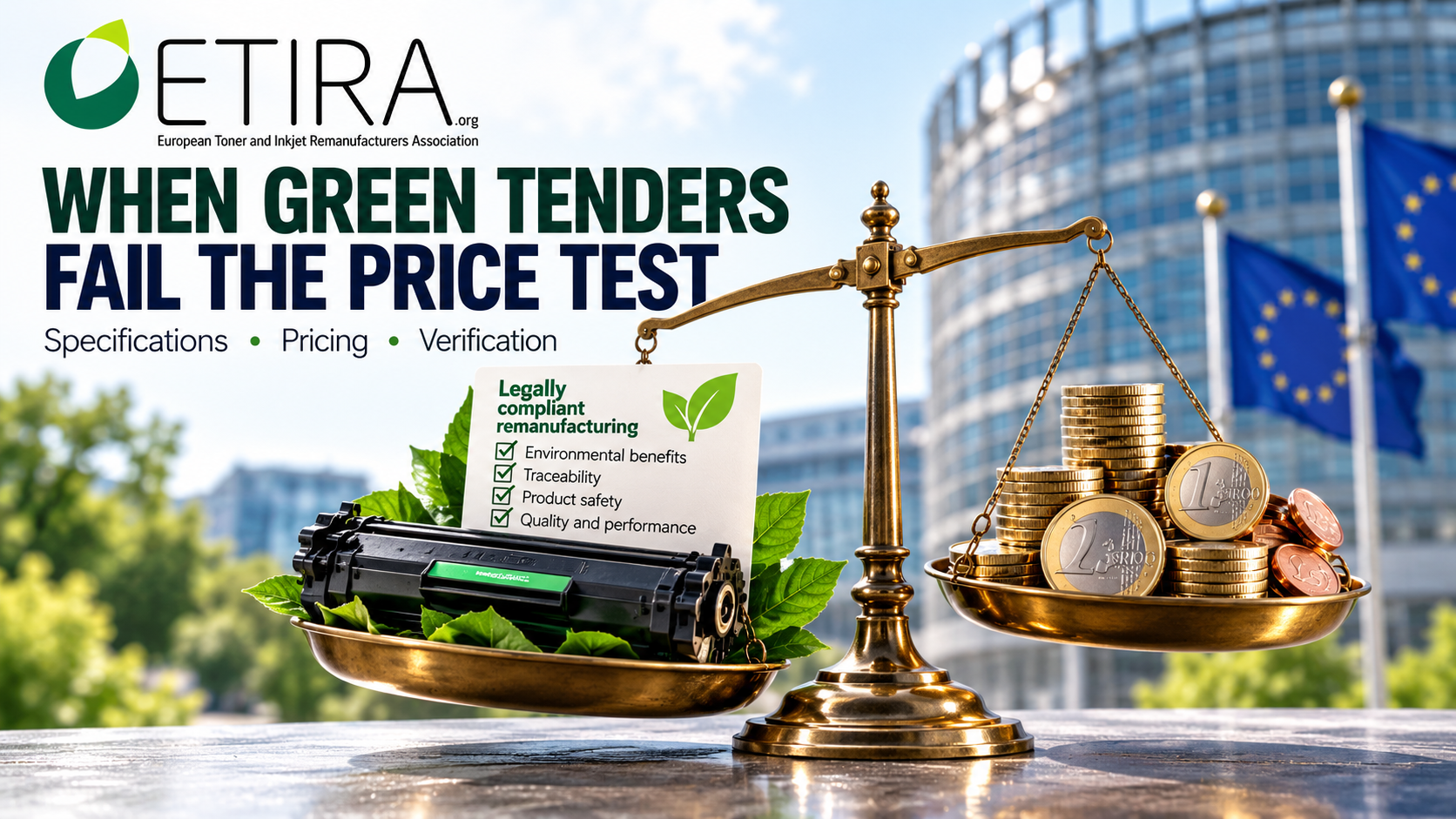
ETIRA examines how unrealistic pricing and inadequate verification can undermine public procurement of legally compliant remanufactured cartridges.
A recent Italian public tender for remanufactured toner cartridges has raised a question extending far beyond Italy. Can public authorities achieve their environmental objectives if the prices they expect to pay for remanufactured products are commercially unrealistic?
Across Europe, public procurement increasingly supports sustainability, resource efficiency and the circular economy. Remanufactured toner cartridges extend product lifecycles, retain valuable materials and reduce waste.
The commercial significance is considerable. A preliminary examination of notices published through the EU’s Tenders Electronic Daily (TED) database between 15 July and 15 October 2026 identified 13 cartridge-related procurement notices with disclosed estimated values totalling approximately €6.1 million. This limited sample is not a comprehensive estimate of European expenditure, and some notices require further verification of their cartridge-specific scope. Nevertheless, it illustrates the scale of public purchasing opportunities.
Yet there is a fundamental difference between specifying a sustainable product and actually purchasing one.
A contracting authority can prepare a tender containing demanding technical specifications, environmental criteria and applicable legal requirements. But these ambitions must also be reflected in the commercial conditions under which suppliers compete.
Genuine remanufacturing involves collecting suitable used cartridges, inspecting and processing them, replacing components where necessary and testing finished products. Manufacturers must also meet applicable product safety, chemical, environmental and waste management requirements.
All this costs money.
Businesses have different cost structures, and competitive pricing is desirable. However, exceptionally low prices raise reasonable questions about whether specified products can genuinely be supplied while meeting every requirement.
A remanufacturer investing in compliant processes, testing and environmental management may find a tender commercially unattractive and decline to participate. Other suppliers may submit lower offers, but price alone tells the authority little about how they intend to meet the specifications.
The risk is that procurement intended to support circularity inadvertently discourages the businesses it seeks to encourage.
The Difference Between Promising and Delivering
Another concern is familiar to Europe’s remanufacturing industry. Established manufacturers are sometimes approached by companies preparing public contract bids and asked to provide quotations, technical information and evidence of compliance. Their products may help bidders demonstrate that tender requirements can be satisfied.
Yet remanufacturers report occasions when, despite a bidder securing the contract, the anticipated orders never materialise.
There can be legitimate explanations, and the absence of orders does not establish wrongdoing. Nevertheless, it raises questions about the relationship between products proposed during a tender and those eventually delivered.
A compliant remanufactured cartridge could help secure a contract without ever being supplied under it.
This is why verification matters beyond the initial award. Where bids are assessed using particular products, manufacturers or supporting documentation, contracting authorities should ensure that deliveries continue to meet the agreed specifications throughout the contract.
This is particularly important for multi-year arrangements. Initial deliveries may meet every requirement, while later supplies could involve different products. Without ongoing checks, compliant remanufactured cartridges risk being replaced by cheaper, non-compliant newbuild alternatives.
A low price does not automatically indicate non-compliance, just as a higher price does not guarantee compliance. But relying solely on declarations submitted during the tender process can leave a gap between products promised and those delivered.
Periodic verification throughout the contracted supply period is therefore essential. Depending on applicable requirements, this may involve checking product identification, traceability, environmental documentation, evidence of remanufacturing and product quality.
No single certificate establishes compliance with every obligation. Authorities must understand which requirements apply and what constitutes credible evidence.
European procurement rules provide mechanisms for examining apparently abnormally low offers. These should establish whether suppliers can fulfil the specifications rather than treating the lowest price as sufficient justification for an award.
For ETIRA, the concern is not competitive pricing itself. It is that environmental and legal requirements lose their practical significance when price and compliance verification are considered separately.
Turning Environmental Ambition into Results
The European Union is considering further reform of its public procurement framework, including greater recognition of circular economy activities and lifecycle considerations. This offers an opportunity to examine how authorities ensure their purchasing decisions deliver the intended outcomes.
ETIRA believes legally compliant remanufactured cartridges should compete fairly on quality, performance, reliability, environmental benefits and lifecycle costs. Genuine efficiencies should be recognised, while every supplier must meet the same applicable standards.
This requires a clear connection between tender specifications, commercial conditions and verification of products actually supplied. Authorities need not abandon competitive purchasing. They must ensure competition takes place between products genuinely meeting their requirements.
Even a tender containing excellent environmental specifications can fail to deliver circular economy benefits if those requirements are not reflected in the products purchased.
A green tender is not necessarily a green purchase.